
The Death of Search as We Knew It: How AI Became the New Gatekeeper of the Internet
Google Is No Longer a Website Finder
The era of "ten blue links" is functionally over. Google's I/O 2026 overhaul turned Search into an AI answer engine that keeps users on the results page. Zero-click searches now account for 60% of queries, and publisher traffic is collapsing as a result. Google called it the biggest change to its search box in 25 years.
Google's head of Search, Elizabeth Reid, put it plainly at I/O: "Now, we're entering the next chapter of Google Search, where incredible AI features aren't just in Search — Google Search is AI Search through and through. We're entering the era of search agents now."
What does that mean in plain English? Google no longer points you to the web. It is the web — or at least, it wants to be. In short, Google wants to replace web pages entirely, serving you redigested content without ever sending you to the original source.
The 93% Number: AI Answers Replace Website Visits
The statistics on how few clicks actually reach websites now are staggering.
According to Semrush data updated in September 2025, 93% of searches conducted in AI Mode end without a single click to an external website. Ninety-three percent. For anyone who lives on organic traffic, this is an existential crisis.
For news-related searches specifically, zero-click rates rose to 69% in the year after AI Overviews launched, according to Similarweb data. Google search traffic to publishers fell 33% globally in the year to November 2025.
Multiple large-scale studies published in 2025–2026 paint a consistent picture: zero-click searches have risen from 54% to 72% of all queries where AI Overviews appear. Reaching position one — the gold standard of SEO for two decades — now earns less than half the traffic that same ranking would have generated in 2024.
AI Companies Don't Need Websites — They Just Need Their Content
Here's the brutal math that explains why AI companies have no incentive to send you traffic:
A decade ago, the relationship between creators and Google was balanced. For every two pages Google's bot crawled on your site, it sent you one visitor. A fair trade. Today, that ratio has deteriorated dramatically — Google now needs to analyze six of your pages to send you a single click. But what Google started, generative AI has pushed to an apocalyptic extreme. The ratio for OpenAI is not 6-to-1 but 1,500-to-1. ChatGPT vacuums up 1,500 pages of your content, feeding on it to refine its models — and sends you essentially nothing in return.
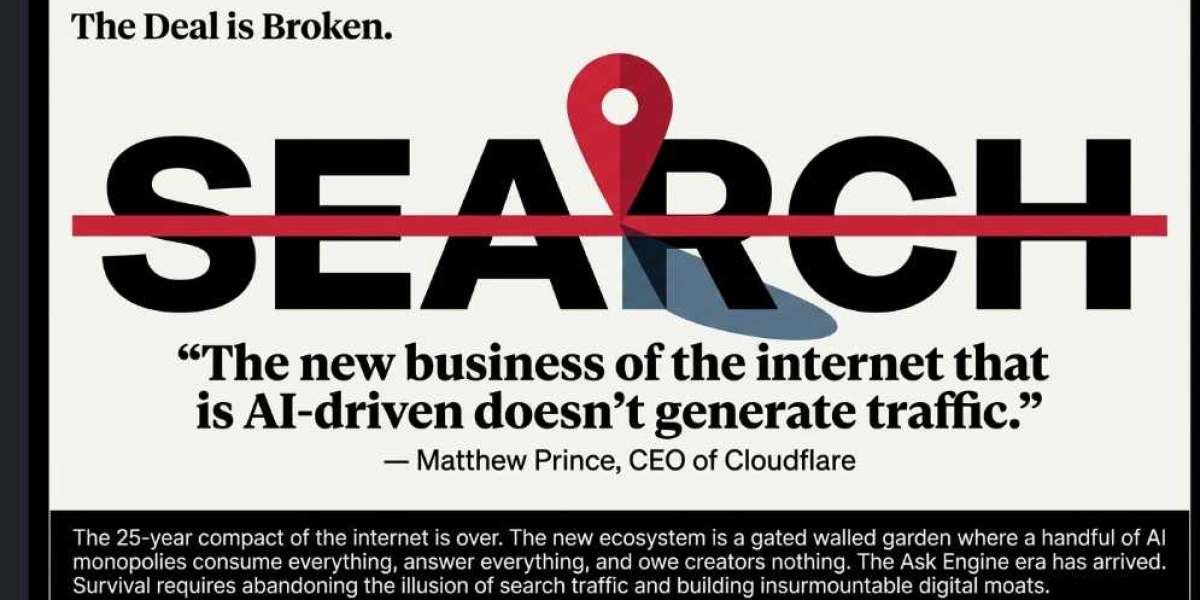
As Cloudflare CEO Matthew Prince summarized: "The new business of the internet that is AI-driven doesn't generate traffic." Before the rise of AI chatbots, websites allowed search engines to access their content in return for increased visibility — a system that rewarded them with traffic and advertising revenues. That deal is now broken.
The "Gated Community" of AI Scraper Companies
The AI industry has effectively built a walled garden fed by the open web — and that open web is now dying from the inside out.
As researcher Audrey Hingle writes in her paper Getting Bots to Respect Boundaries: "The actors extracting the most value from large-scale crawling are largely insulated from the costs it creates, which are absorbed by publishers. They must respond by restricting access in order to survive." Over time, "this risks accelerating enclosure: more gated content, more limited access, and a web that is harder to participate in."
A nonprofit called Common Crawl — which has been archiving the web since 2013 — has become the unexpected flashpoint in this battle. Investigations found that despite publishers submitting takedown requests, Common Crawl's archives still contained the supposedly removed content. The organization's file format is "immutable." Once data is archived, nothing can be truly removed — creating a backdoor for AI companies to access premium journalism never meant to be free, train their models on this content without licensing fees, and profit from publishers' work without compensation.
Some chatbots have even been found serving content behind paywalls — getting behind subscription walls that were supposed to protect publishers' revenue.
The Publisher Apocalypse: The Numbers Are Devastating
The damage to the websites that built the web is not abstract. It is being measured in jobs, closures, and existential collapse.
Publishers have been surprisingly candid about losing 20%, 30%, and in some cases even as much as 90% of their traffic and revenue over the past year. Some smaller publishers have already been forced to shut down, and more will no doubt join them in 2026.
Specific casualties documented:
- HubSpot estimates it lost 70 to 80% of its organic traffic. Chegg, the education platform, reported a 49% decline. DMG Media documented drops as steep as 89% for some queries. NPR called it an "extinction-level event" for online news publishers.
- Business Insider saw its organic search traffic fall by 55% between April 2022 and April 2025, leading the company to cut 21% of its staff. HuffPost's desktop and mobile sites lost half of their search referrals over the same period.
- Major publications have described this as the "traffic apocalypse" (Columbia Journalism Review), "AI armageddon" (Wall Street Journal), and The Economist simply declared "AI is killing the web."
From Search Engines to "Ask Engines"
The fundamental nature of discovery online has shifted from finding to asking.
Search is no longer just about typing queries into Google and waiting for a list of blue links. It has evolved into a conversation — whether through ChatGPT, Google's AI Overviews, or platforms like Perplexity, users are bypassing traditional search behavior in favor of AI-generated answers.
Perplexity AI explicitly positions itself as an "answer engine" — a hybrid tool blending the best of search and generative AI that competes directly with traditional search giants like Google.
In 2026, many users begin with an AI-generated answer, a synthesized overview, a voice response, or a conversational interface that pulls from multiple sources at once. Traditional SEO still matters, but it is no longer sufficient on its own. If your content cannot be easily understood, extracted, trusted, and cited by answer engines, it will lose ground — even if it still ranks in classic search.
The competitive field now looks like this: AI Overviews and summaries now appear on a large share of U.S. queries and can reduce organic clicks by 58–70% when they show up. Standalone AI answer engines — ChatGPT, Gemini, Perplexity, Claude — are where users increasingly go first for research, coding help, and decision support.
Who's Winning in This New World
Perplexity AI hit 780 million monthly queries in 2025, growing 340% year-over-year. The revolution it represents: answers in 2 seconds vs. clicking through 10 links. Google Search, meanwhile, is drowning in its own ads, SEO spam, and AI hallucinations.
Perplexity's ambition goes further — its "Model Council" feature allows users to simultaneously compare GPT-5, Claude, and other models on the same query, positioning Perplexity not just as a search engine but as an AI evaluation framework and meta-platform for AI itself.
Google's search share has already slipped from 92.9% in 2023 to around 89.6% in mid-2025 — the steepest decline in the company's history.
The Deeper Question: Can the Web Survive?
The deeper question is whether the web can survive a search engine that no longer needs it. If publishers lose enough traffic, they stop producing the content that trains and feeds AI models in the first place. Google is betting on AI as the future of search. The rest of the internet is left to hope that bet does not come at their expense.
Large tech firms have built monopolistic platforms that siphon value but contribute little original content. Content producers need stronger collective bargaining power to negotiate with AI firms. Regulation should require AI systems to attribute and compensate sources. The current path could lead to a digital world dominated by derivative content with no incentives to create new work.
Publishers may lose over 40% of search traffic to AI-driven answer engines by 2026 — platforms that deliver information without clicks, reducing website referrals. To stay relevant, publishers and startups are pivoting to unique content that AI can't easily replicate: investigative journalism, diverse media formats like video, and community-driven strategies. New monetization methods — like subscriptions and partnerships with AI platforms — are now essential as traditional ad revenue declines.
The bottom line: We are witnessing the dismantling of the 25-year-old compact that built the internet — content creators make things, search engines index them and send traffic back. AI has broken that deal permanently. The new internet is a gated ecosystem where a handful of AI companies consume everything, answer everything, and owe the creators of the original content nothing. The "ask engine" era has arrived, whether the web is ready or not.